
Introduction: The MVP Trap Most AI Startups Fall Into
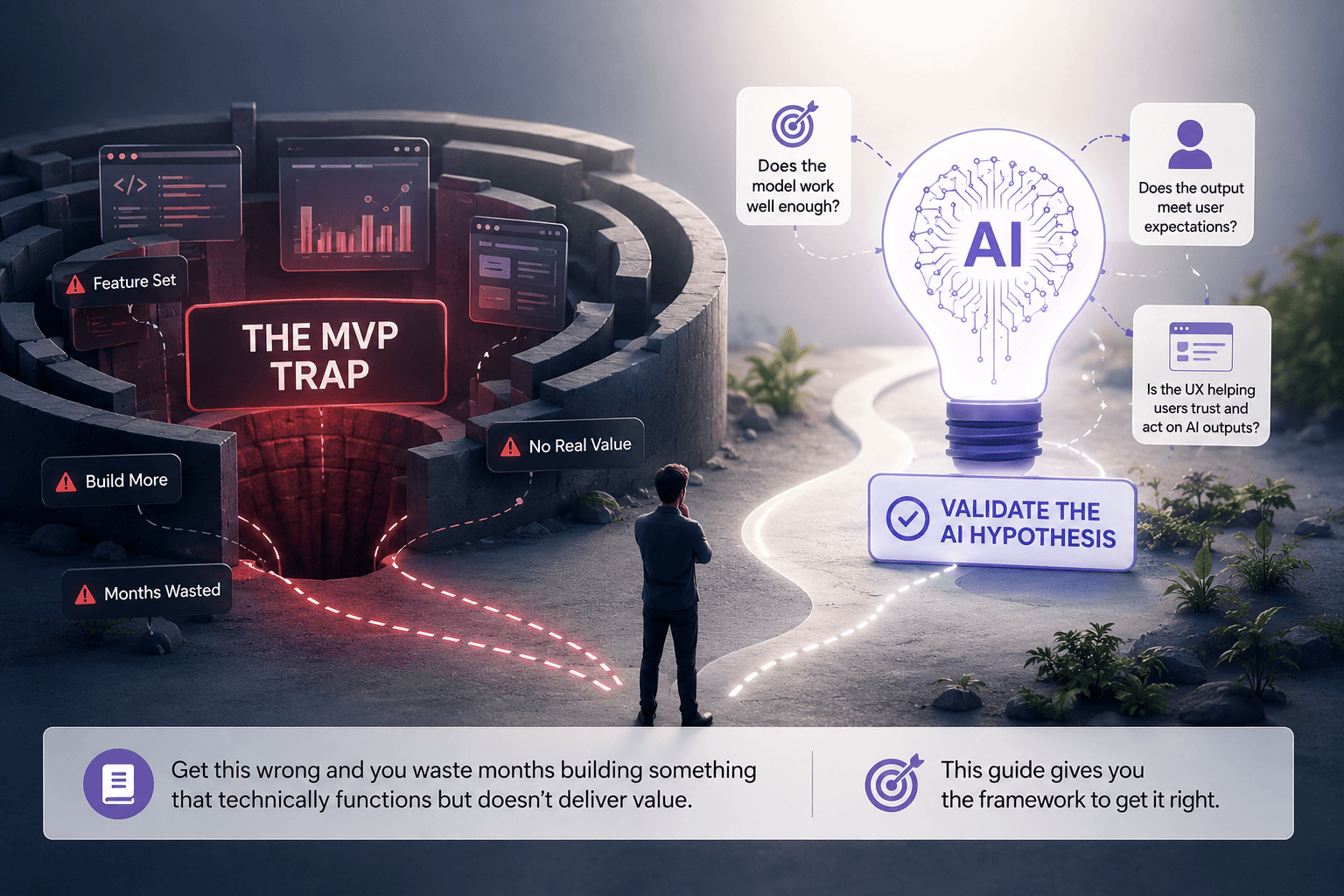
Most founders know they need an MVP. What many don't know is that AI product MVPs are fundamentally different from regular software MVPs. You're not just validating a feature set - you're validating an AI hypothesis. Does the model work well enough? Does the output meet user expectations? Is the UX helping users trust and act on AI outputs?
Get this wrong and you waste months building something that technically functions but doesn't deliver value. This guide gives you the framework to get it right.
Step 1: Define the AI Hypothesis, Not Just the Product Idea
Before building anything, clearly state what AI capability your product depends on and what "good enough" looks like.
For example:
"Our AI can classify customer support tickets with >90% accuracy, reducing resolution time by 30%."
This gives you a testable success criterion - not just a feature list.
Questions to Answer
What does the AI need to do?
What accuracy / quality level is acceptable for MVP?
What data do you need to achieve it?
What happens when the AI is wrong?
Step 2: Validate the Data Before the Model
The biggest hidden risk in AI MVPs is data. Most teams discover too late that their data is incomplete, unlabeled, or structurally wrong for the model they had in mind.
Spend the first two weeks in a data audit - understand what you have, what you need, and how you'll get more.
Step 3: Design the AI UX First
Most teams design the backend AI, then slap a UI on top. We do it in reverse.
Designing the user experience first forces you to answer the hard questions:
What does the AI output look like to a user?
How do you handle uncertainty?
How do users correct the AI?
Starting with UX also gives you a clickable prototype you can show investors and users before a single model is trained - which means faster validation with real feedback.
Step 4: Start with the Simplest Possible Model
You don't need GPT-4 for your MVP.
Start with the simplest model that could plausibly work. Fine-tune if necessary. The goal is to test your core AI hypothesis - not to build the most sophisticated architecture.
You can optimize later.
Best Practices
Use pre-trained foundation models where possible.
Fine-tune on a small, high-quality dataset.
Test with real users as soon as the output is "good enough."
Iterate on model quality based on real user feedback, not internal benchmarks.
Step 5: Build a Human-in-the-Loop Safety Net
For MVP, especially in high-stakes domains, design a human review layer for low-confidence AI outputs.
This isn't a weakness - it's a feature.
It means your product can launch before the model is perfect, and the feedback loop from human corrections makes the AI better over time.
What Does It Cost and How Long Does It Take?
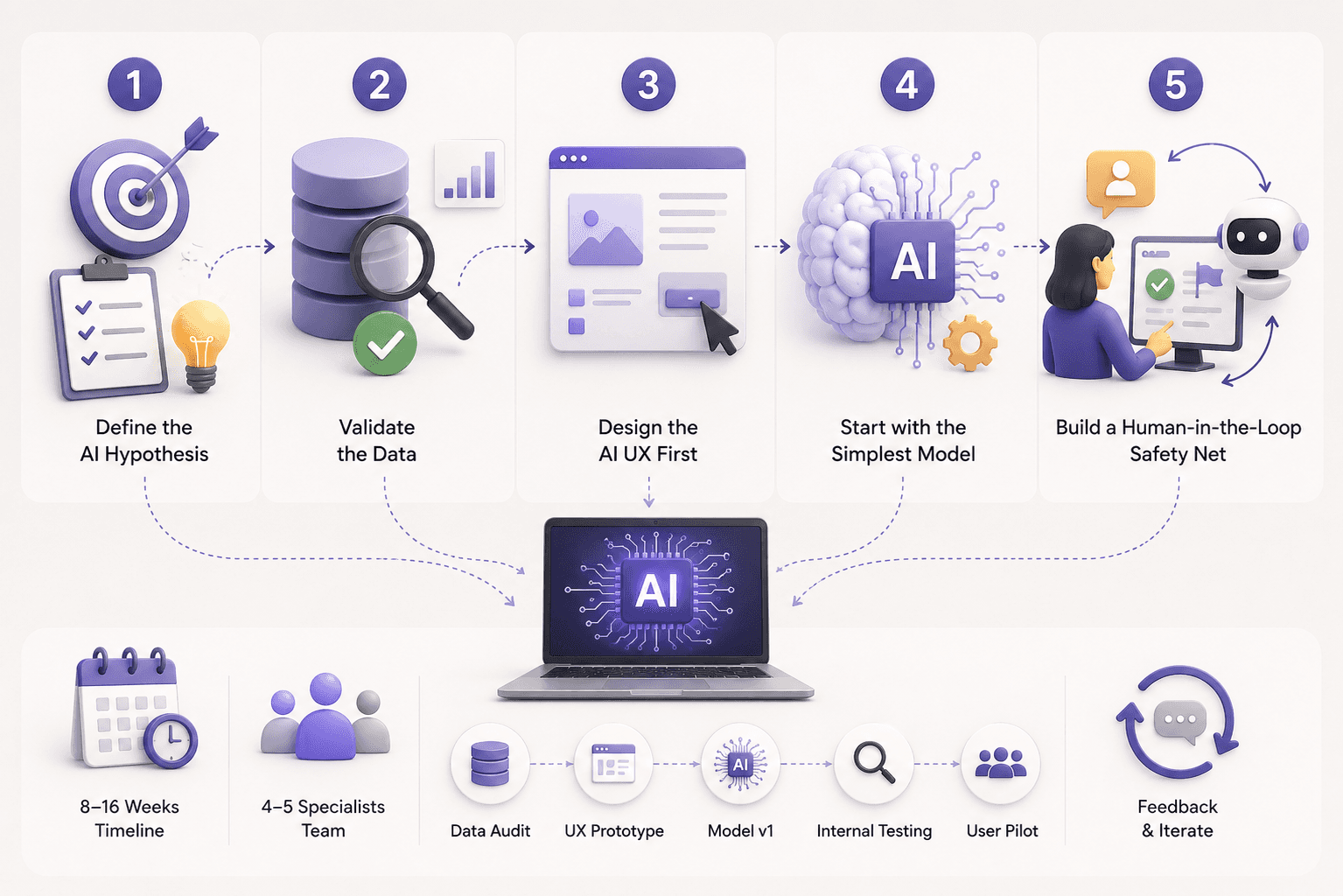
A well-scoped AI MVP typically takes 8–16 weeks and involves:
A product strategist
1–2 ML engineers
A UX designer
A backend developer
At Palpx.ai, we've delivered production-ready AI MVPs in as little as 6 weeks by running design, data work, and model development in parallel.
Typical Timeline
Timeline: 8–16 weeks for a well-scoped MVP
Team: 4–5 specialists (or an AI product agency that has all of them)
Key milestones:
Data audit
UX prototype
Model v1
Internal testing
User pilot
Conclusion: The Right MVP Proves the AI Works for Real People
A successful AI MVP doesn't just show that the model works.
It shows that real users, in real conditions, get real value from the AI output.
That's the bar.
Everything else is just engineering - and engineering is solvable.